
For veterinary clinics and hospitals
Your clinic’s app, by Miah.
The treatment you prescribe, followed at home. Owners get Miah’s App with your clinic’s brand: the prescription becomes a checklist the whole household ticks off, and your contact is one tap away.

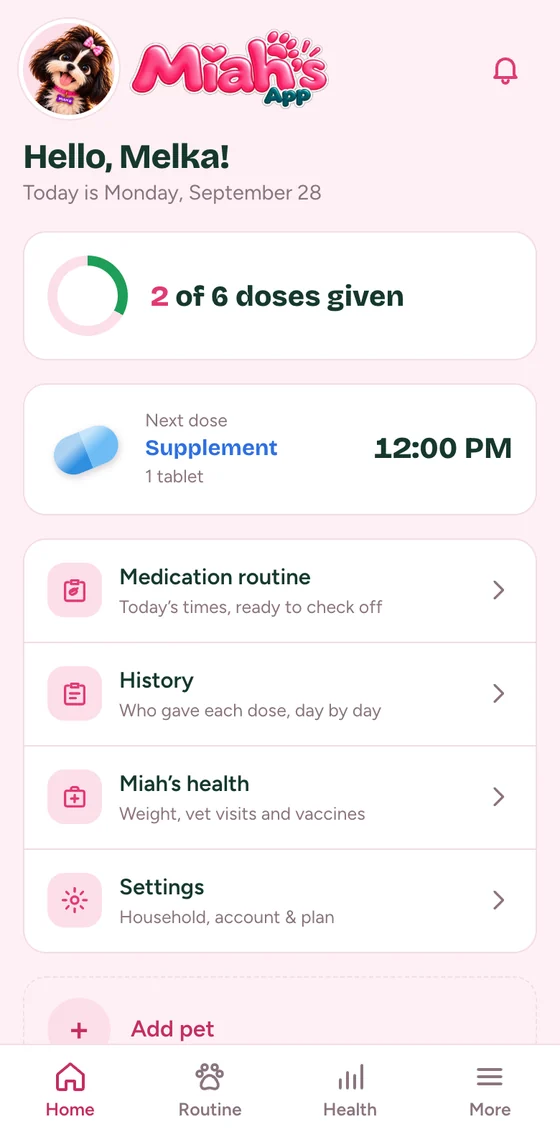

And after discharge? ♡
After discharge, the plan becomes a sheet of paper on the fridge.
Several people giving meds, drops and tablets at different times, an end date — and the clinic only finds out at the recheck, or when the pet comes back worse. Miah’s App takes your plan home.
Getting started
No integration, no hardware. Four steps.
Pick a plan
From 100 to 1,000 pets a month.
Print the cards
Discharge cards with your brand and QR, as a PDF.
The owner scans
Account in a minute; the pet gets 90 days of access.
Your team follows
Email and password, from any browser.
Nothing to change in your practice software. The front desk hands out the card with the discharge papers.
The clinic portal
Your team sees who needs a call today: overdue doses, owners who stopped using the app, 7-day adherence and vaccines coming due. Only for pets whose owner said yes.
Unlock for one clientowner with several patients? Create a code just for them, 1 to 4 pets
Monthly balancehow many pets are left this month
Your contact in the appowners reach you in one tap
English and Portugueseportal and app in both, weight in pounds

Monthly pricing
The clinic pays per pet.
Owners pay nothing.
90 days per petEach pet gets 90 days of the full app.
Only used when addedA credit is used only when the owner adds the pet. Unused pets don’t roll over.
Free for ownersThe app is a benefit your clinic gives its clients.
Consent first ♡
Owner permission
Pet by pet, and they can turn it off anytime. Without it, the clinic sees nothing.
Only what’s needed
The clinic never sees prescription photos, weight, notes or contacts.
Doesn’t prescribe
It organizes what the vet prescribed. It never changes a dose or replaces a visit.

Why “Miah”? The story behind the app
Nobody is ready to hear the word “tumor” about someone who has slept at the foot of your bed for almost twelve years.
Miah was a 12-pound Shih Tzu, small in size and enormous in everything else. At 11 years and 8 months she had a liver tumor removed, developed pulmonary edema overnight, faced a clotting risk — and came home eating well and demanding her walk.
She also came home with a pharmacy bag that looked like luggage for a long trip: eight medicines and seventeen doses a day. Melka and I turned into a small home ICU, splitting shifts through the night, each “✓” passed between us like a baton.
A sheet of paper on the fridge, or a spreadsheet, would never hold. With seventeen doses a day and two people taking turns, nobody opens a spreadsheet at three in the morning — and it can't answer the only question that mattered: has this dose been given, and when?
Miah's app was born right there, out of the need to manage the little one's medicines without missing a single one. It carries her name because the story is hers.
Nathan, Miah's human
Read Miah's whole week
Miah has always been small in size and enormous in everything else. A 12-pound Shih Tzu who lived through moves, projects, late work nights and every phase of our family like someone who always knew this was her place. When the scans showed a liver tumor, her age — 11 years and 8 months — weighed on the conversation. You don't take a lady that age into surgery lightly. But the alternative was not giving her the chance to fight, and that was never on the table.
The surgery
On September 5 we handed Miah over to the surgical team. The hours you wait through an operation run on their own kind of slow: phone in hand, eyes going back to the screen for no reason, trying to work on anything at all just to stop counting minutes.
She came off the table. The tumor came out of her.
The first labs afterward showed what you'd expect from a body fresh out of a fight: high lactate, the whole system sending the bill for the procedure. Nothing off-script for major surgery — but the script was about to change.
The call at 3 AM
There's a kind of ringtone you recognize before you answer. In the middle of the night the screen lit up with the hospital's number, and into that one second between seeing it and answering fit a fear the size of the world.
“Miah had a complication. She's stable.”
Stable. The word that grabs you by the collar at the edge of the cliff. Her lungs had filled with fluid — pulmonary edema, with suspected aspiration pneumonia — and she needed oxygen. Her enlarged heart told a story her age had been hiding. Over the next hours the tests filled in the picture: the X-ray confirmed the lungs, and a clotting panel showed her blood was clotting too much, a silent risk circling everything.
Sleep, that night, was a verb that refused to conjugate.
The turn
And then Miah did what she had been doing since 2015: she surprised everyone.
The next evening the team weaned her off the oxygen little by little, and she kept up. In the morning the overnight vet's message read like a sunrise in text: off oxygen, 96% on room air, stable pressure, chest ultrasound improving. And the detail that made us laugh with our chests still tight: she ate. With appetite. And walked the ward like someone inspecting the premises.
Eleven years, eight months, an operated liver, lungs that two days earlier needed help to work — and the lady eating with gusto and pulling toward the door for a walk.
The next clotting panel confirmed it: the piece of liver that stayed behind was doing its job. The team set up the anticoagulation, adjusted every medicine, and the word we hadn't dared say out loud entered the conversation: discharge.
Coming home
She came home Sunday night, along with a pharmacy bag that looked like luggage for a long trip: eight medicines, seventeen doses a day, drops, tablets split in halves and quarters, saline nebulization. We turned into a small home ICU running on phone alarms and love — Melka and I splitting shifts through the night, every dose ticked, every “✓” passed between us like a baton.
And Miah? Miah slept in her own house. Woke up in her own house. Ate, drank, did her business with the usual dignity, and breathed — twenty-three breaths a minute, counted one by one by a dog dad who learned that week to read her body in numbers — at the easy rhythm of someone who is home.
What stays
She had almost two more weeks at home. She ate with appetite, demanded her walk on time, and slept at the foot of the bed — the place that had always been hers. She died in the early hours of Saturday, September 19, 2026.
She faced a tumor, liver surgery, pulmonary edema, a clotting risk and a whole hospital stay — and came home eating well and demanding her walk.
Some call it luck. Anyone who knew Miah knows better: it was personality.
Eleven and a half years. Twelve pounds. Not much body for so much life.
This app exists because seventeen doses a day don't fit in anyone's head. And it stays on its feet because, right now, other families are living the week we lived — the same fear, the same pharmacy bag, the same question at three in the morning. That is what she left: Miah looking after other animals, by proxy, without ever knowing it.
Miah · April 1, 2015 — September 19, 2026. She taught us that 12 pounds is more than enough room to hold a strength like that.

Let’s try it with your clinic’s patients?
contato@miah.app.brAlready a partner? Sign in to the portal
Your plan, followed at home. ♡